
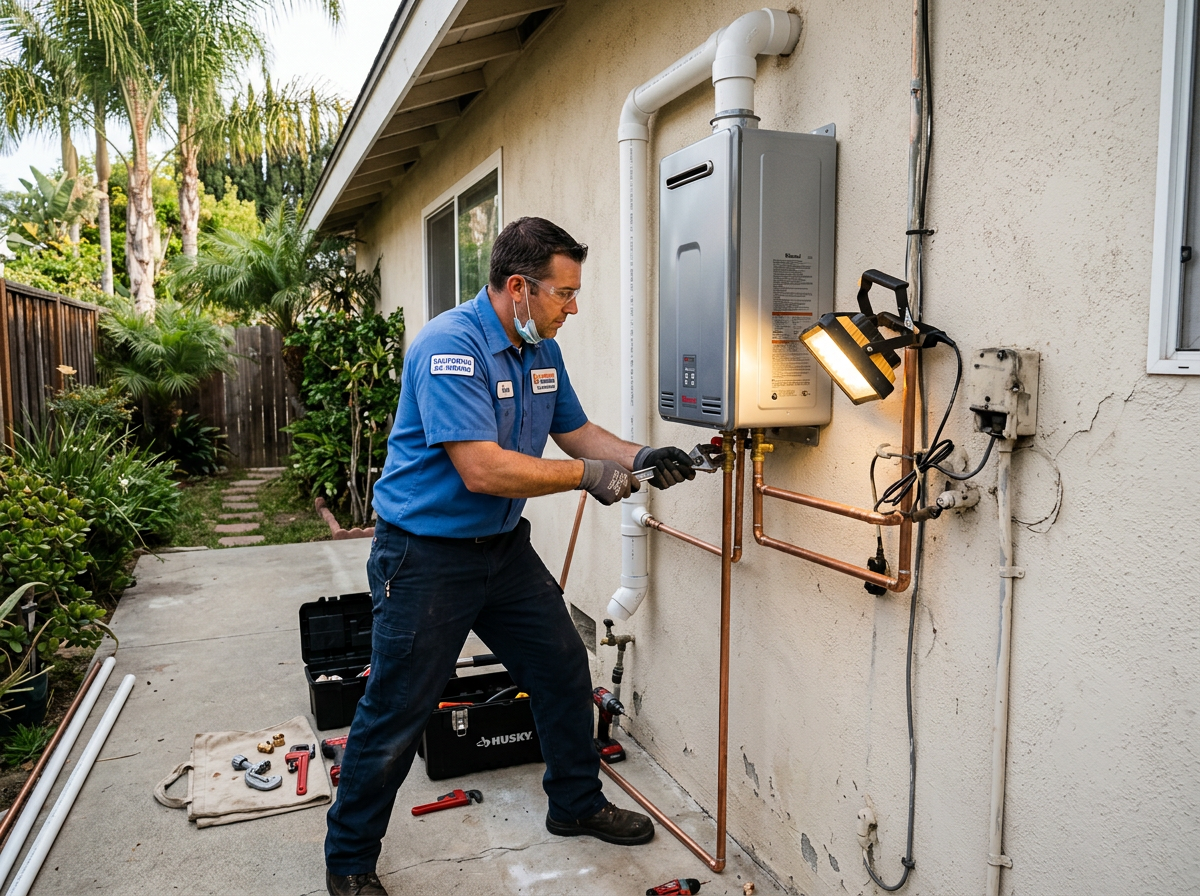
Tankless units demand larger gas lines than most existing residential runs in Torrance homes built before the 2000s, and installers who skip upsizing see the unit short-cycle or fail to reach set temperature on multiple fixtures. Dedicated stainless-steel venting must run with the correct slope and termination clearances; inspectors reject jobs where single-wall pipe is used or where the vent shares a chase with a furnace without proper separation. In coastal Torrance the incoming water temperature stays milder, but foothill and inland jobs often see winter supply drop below 55 degrees, cutting flow rate at the shower head even on correctly sized units.
Hard water across the South Bay and inland valleys leaves scale on the heat exchanger within the first year if annual descaling is skipped, and the resulting restriction shows up as error codes rather than obvious leaks. Proper conversion from a tank includes removing the old unit, capping or rerouting lines, and verifying the thermal expansion control on the cold side so the T&P valve does not weep after the new unit is commissioned. Homeowners who choose the smallest unit to save on the initial quote frequently discover it cannot handle simultaneous dishwasher and shower use once winter groundwater arrives.
Tankless Water Heater Installation Near You — Choose Your City
Every city below has its own local Tankless Water Heater Installation page with coverage details.
San Diego County
El Dorado County
San Joaquin County
Riverside
Sacramento County
Sacramento
Riverside County
San Diego
Monterey
Placer County
Orange
Yolo County
Calaveras
Los Angeles County
Sutter
San Bernardino
San Mateo County
Sutter County
Placer
Amador County
Ventura
El Dorado
Los Angeles
Yuba
Solano
Amador
Marin County
Monterey County
Recirculation loops added during install keep hot water at fixtures but require a dedicated return line and a pump sized for the loop length; without it, the tankless unit cycles every time a distant faucet opens. Installations that pass inspection still fail early when the gas meter or regulator cannot supply the required volume at the new demand, a check that must happen before any pipe is run.
Technician insight
In Torrance the thing that catches most people out with Tankless Water Heater Installation is the 1960s-1970s homes where the gas line from the meter is still half-inch; that single run forces an upsizing that adds more cost than the unit itself.
South Torrance Ranch Conversion
Homeowner wanted tankless for space reasons but the existing half-inch gas line could not support the unit. We ran new three-quarter-inch line from the meter and installed a dedicated stainless vent through the attic. After commissioning, the unit delivered steady temperature at two showers even on the coldest January morning.
Tankless Water Heater Installation Services We Offer
✓Gas Line Upsizing
Measure existing pipe capacity and run new black-iron or CSST lines sized for the tankless demand so the unit receives full input BTUs without pressure drop.
✓Dedicated Stainless Venting
Install manufacturer-specified stainless vent pipe with proper slope, supports, and termination to meet California mechanical code and pass inspection.
✓Tank-to-Tankless Conversion
Remove the existing tank, adapt supply and return lines, add seismic strapping where required, and confirm condensate drainage and expansion control on closed systems.
✓Annual Descaling and Flush
Perform vinegar or citric-acid flush through the heat exchanger to remove scale common in South Bay and inland hard water before error codes appear.
✓Recirculation Setup
Add a dedicated return line and pump so hot water reaches distant fixtures without waiting for the tankless unit to fire.
How it works
- 1
Site Assessment
Measure gas pipe size, vent path, incoming water temperature, and fixture count to determine required upgrades before any work begins.
- 2
Gas and Vent Planning
Specify new gas line diameter and stainless vent routing that satisfy both manufacturer specs and local inspection requirements.
- 3
Unit Mounting and Connections
Secure the unit, run dedicated venting, connect upsized gas, water lines, and condensate drain, then integrate any recirculation loop.
- 4
Commissioning and Testing
Purge air, verify combustion, test multiple fixtures for flow and temperature, and confirm no error codes before leaving the site.
Pricing
Scope changes with gas line length, vent run complexity, and whether recirculation is added; call for an on-site assessment at 2430 Amsler St Ste C, Torrance.